
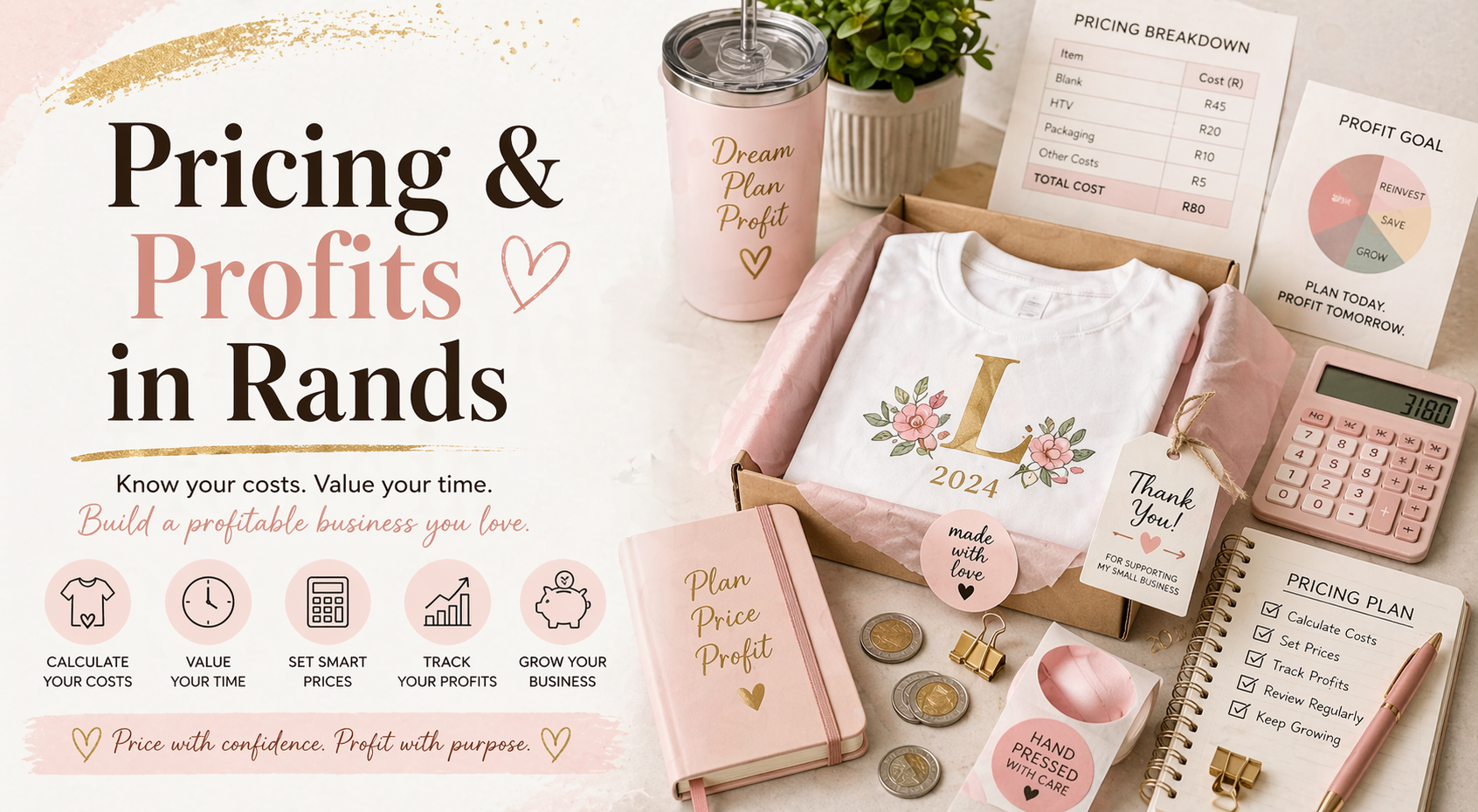
💰 Module 9: Pricing & Profit (in Rands)
Turning Effort into Sustainable Income
Pricing isn’t just about picking a number.
It’s about building a business that:
- Pays you
- Covers your costs
- Actually grows
If you’re not pricing for profit…
you’re funding your business instead of it funding you.
📉 STEP 1: Know Your “True” HTV Costs
Before you quote anything, you need one thing:
👉 Clarity on what it actually costs you
🧾 1. Materials
- The Blank
T-shirt, tote, baby grow
(Include supplier shipping!) - HTV Used
Average chest design: R15–R25 - Packaging
Box, tissue, sticker, care card
⚙️ 2. Equipment & Extras
These are the sneaky ones people forget:
- Blade + cutting mat wear → R2–R5 per item
- Electricity (your heat press isn’t free)
- Transaction fees (Yoco / PayFast ±3%)
💡 Your Real Cost =
Materials + Packaging + Wear & Tear + Fees
If you don’t calculate this…
you’re guessing.
⏳ STEP 2: The “Time” Truth
This is where most people struggle.
Because yes… your time matters.
But pricing hourly per item doesn’t always work in this space.
🧠 The Smart Strategy
⚡ Standard Items
(Simple names, basic designs)
👉 Focus on:
- Speed
- Efficiency
- Volume
💎 Premium Items
(Detailed designs, custom layouts)
👉 This is where you:
- Charge a Design Fee
- Price for complexity
Because weeding + layout = time
📊 Example: Personalised Baby Grow
| Item | Cost |
|---|---|
| Baby Grow | R35 |
| HTV | R20 |
| Packaging | R10 |
| Total Cost | R65 |
💰 Selling Price:
👉 R150 – R195
(Depending on design + packaging experience)
🧠 Reality Check
You’re not just selling fabric.
You’re selling:
- Personalisation
- Skill
- Time
- Experience
🛡️ STEP 3: Protecting Your Profit
This is where your business survives long-term.
🔄 Review Prices Regularly
Every 3–6 months
Because in SA:
- Supplier prices change
- Fuel affects everything
👉 If your costs go up… your prices must too.
💼 The Buffer Fund
Set aside 5% of every sale
This covers:
- New blades
- Mats
- Unexpected costs
No panic. No stress.
🚫 Avoid the Discount Trap
Discounting trains customers to expect cheap.
Instead:
👉 Offer bundles
Example:
- 1 shirt = R150
- 3 shirts = R400
Customer feels like they win
👉 You increase order value
🏦 STEP 4: Think Like a CEO
This is a mindset shift.
💳 Separate Business Account
This is non-negotiable if you’re serious.
Why?
Because mixing money =
👉 Confusion
👉 No clarity
👉 No growth
💡 The Goal
- All income goes into business account
- All expenses come from there
- You pay yourself a “salary”
Even if it’s:
👉 R500/month
It builds discipline and respect for your business.
🚀 CHANTELLE’S PRICING POWER PLAN
✅ Step 1
List your top 5 products:
- Tote
- Baby grow
- T-shirt
- Hoodie
- Apron
✅ Step 2
Calculate true cost for each
✅ Step 3
Set your:
👉 “Minimum Yes Price”
The lowest price where you still feel:
✔ It’s worth it
✔ You’re not drained
✔ You’re making profit
✅ Step 4
Create a bundle:
Example:
👶 “New Mom Set”
- Baby grow
- Matching tote
Higher value. Easier sell.
💡 The Real Question
“Am I profitable… or just busy?”
Because busy doesn’t pay bills.
Profit does.
Bonus Section: Running the money side of your business
Making beautiful products is the fun part. Knowing whether your business is actually profitable is the part most crafters avoid — until they look up one day and realise they’ve been busy but not making money. This lesson changes that.
You don’t need an accountant, a fancy system, or a business degree. You need a simple habit and the right template. That’s it.
💡 The mindset shift first
From the moment you take your first paid order, you are running a business — not a hobby. That means money coming in needs to be tracked separately from money going out, and the difference between the two is what tells you whether you’re actually growing.
Most small business owners who fail don’t fail because they couldn’t make or sell. They fail because they didn’t know their numbers until it was too late. You’re not going to be one of them.
📊 The three numbers that matter
1. Revenue
Every rand that comes in from a sale. Not profit — just the total amount customers pay you.
2. Cost of Goods (COG)
Everything you spent to make that specific product — blank, vinyl or HTV, packaging, and any delivery cost you absorbed. This should already be familiar from the pricing lesson.
3. Profit
Revenue minus COG. This is what you actually made. Not what you invoiced — what you kept after the materials were paid for.
Example: You sell a personalised tumbler for R150. The blank cost R45, the vinyl R12, and the packaging R8. Your COG is R65. Your profit on that one sale is R85 — a 57% margin. That’s a healthy product. If your margin drops below 40% consistently, your pricing needs adjusting.
📋 What to track every month
| Category | What to record | Examples |
|---|---|---|
| Sales income | Every paid order | Tumbler R150, gift set R320 |
| Material costs | Vinyl, HTV, blanks, packaging | Vinyl roll R120, 10 tumblers R450 |
| Equipment costs | Machine, press, accessories | Cricut mat R95 (once-off) |
| Business costs | Course fees, software, marketing | Canva Pro R199/month |
| Delivery costs | Postage, courier, packaging | Postnet parcel R85 |
📅 Your monthly check-in (10 minutes)
On the last day of every month, spend 10 minutes answering these four questions:
- How much did I earn this month? (total sales)
- How much did I spend? (total costs)
- What was my profit? (earnings minus costs)
- Which product made me the most profit? (make more of that one)
That’s it. Four questions, ten minutes, once a month. This single habit will keep your business healthy and your pricing honest.
🇿🇦 South African tax basics for small sellers
This is general awareness — not legal or tax advice. For your specific situation, speak to an accountant.
- Under R1 million annual turnover — you are not required to register for VAT. Most side hustles operate comfortably below this for years.
- You still pay income tax on profit from your business, even as a sole proprietor. Keep records from day one — it makes tax season significantly less painful.
- SARS requires you to declare all income — including side hustle income. The tax-free threshold for individuals is currently R95,750 per year (2025). If your total income including your side hustle stays below this, you won’t owe tax.
- Keep all receipts — material costs, equipment, software subscriptions, and even a portion of your home data costs can be legitimate business deductions.
⚠️ The one thing most crafters miss: If you’re buying blanks and materials regularly, keep every invoice and proof of payment. These reduce your taxable income — but only if you have the paperwork.
📥 Your financial tracking spreadsheet
A ready-to-use Google Sheets tracker is included with this lesson. It has three tabs:
- Sales log — record every order as it comes in
- Expense log — record every purchase
- Monthly summary — automatically calculates your revenue, costs, and profit
Make a copy, rename it with your business name, and start filling it in from your very first order.
🎯 Your action task
- Download and open the tracking spreadsheet. Make a copy for yourself.
- Enter your last 3 purchases — vinyl, blanks, packaging, anything. Get into the habit of recording as you spend.
- Calculate your profit margin on your top product using the formula: (Selling price − COG) ÷ Selling price × 100. If it’s below 40%, revisit your pricing before taking more orders.
You don’t need to be a numbers person. You just need to know your numbers. There’s a big difference.